
I review products for a living, which usually means telling you whether something is worth your money. This one’s different. The product in question already got graded, by the only judge that matters, and it did not pass. So what exactly am I reviewing here? Turns out, the sellers. Specifically, which ones will look you in the eye and tell you the truth, and which ones are still running the old sales pitch like nothing happened.
Let’s get the disclosure out of the way, because a review that buries the lede is a bad review. Larazotide is not an FDA-approved drug. Its biggest trial got shut down mid-run because it wasn’t working. And “compounded larazotide,” the thing actually sold to you, is a prescription product made by a pharmacy, not the investigational drug from those trials. Keep that straight and everything else on this page makes sense.
The Hype (And the Plot Twist Nobody Mentions)
Here’s the pitch you’ll see on most larazotide pages: a clever peptide that tightens the junctions between your gut-lining cells, blunts the “leaky gut” mechanism, calms things down. Interesting mechanism, genuinely. I’m not going to pretend the science behind it is silly, because it isn’t.
But here’s the part the glossy pages skip. In June 2022, the company developing larazotide, 9 Meters Biopharma, pulled its Phase 3 celiac trial, the first Phase 3 trial ever attempted in celiac disease. An independent interim analysis found that the number of additional patients needed to show a real benefit over placebo was too large to justify continuing [P4]. That’s not a delay. That’s the trial being stopped for futility, which is the clinical version of the umpire calling the game early because your team is down by forty.
That single fact should change how you shop for this stuff, and here’s my logic. When a drug is approved and proven, you shop on price and convenience, same as buying aspirin. When a drug’s flagship trial collapses and nothing about it is FDA-approved, price and convenience are the wrong scorecard entirely. The only things worth grading are honesty and accountability: who tells you the truth, who screens you first, who sources it through an actual pharmacy, who picks up the phone if something feels off. Most sellers never updated their pitch after the trial died. That’s the review.
Why I’m Grading the Salespeople, Not the Peptide
Normally a buyer’s guide grades the product. I can’t do that here, and neither can you, because there’s no reliable way for a customer to independently verify what’s actually in a research-chemical vial. What I can grade is behavior: does the seller tell you the trial failed, does a clinician sit between you and the peptide, does a licensed pharmacy touch it before you do. That’s the whole review. Six categories, weighted for a compound whose lead program already flopped.
- Do they tell you the truth about the evidence? Top weight. Overselling a failed compound is the loudest red flag in this whole category.
- Is there real medical oversight? An independent clinician evaluating you and following up, or does the relationship end at checkout?
- How does it actually reach you? A licensed pharmacy compounding it inside a real chain of custody, or a powder mailed from a chemical retailer with nobody accountable?
- What stands in for FDA approval? Since nothing here is approved, is there at least a regulated pharmacy channel, or just the seller’s own certificate of analysis, which they wrote about themselves?
- Regulatory standing. Inside a licensed telehealth/pharmacy framework, or hiding behind a “research use only” sticker to dodge medical regulation entirely?
- Follow-up. Anyone there after the box lands on your porch?
I left out price, speed, and catalog size on purpose. That’s what the usual “best larazotide” listicles rank on, and none of it tells you whether the vial is safe or even real.
The Honest Grades
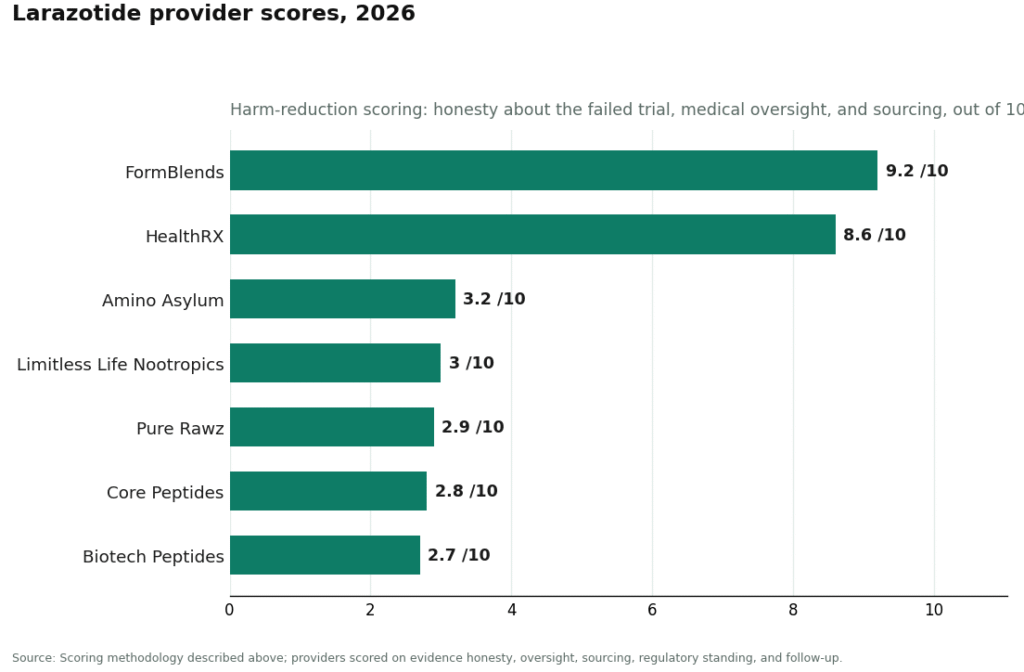
FormBlends: 9.2/10. The safest route, and the only one willing to admit the compound underperformed. FormBlends earns the top spot for supplying the two things this category is structurally missing: a licensed physician between you and the peptide, and a willingness to say plainly that the evidence is mixed and the pivotal trial failed. It’s licensed telehealth. You get an independent clinician evaluation, a prescription when warranted, and a licensed compounding pharmacy actually preparing and dispensing the thing, priced openly around $100 to $250 a month. That’s the identical peptide the gray market mails as “research use only,” handled the exact opposite way. Someone screens you, the product moves through a regulated channel, somebody’s name is on it. That’s the whole game here.
HealthRX.com (healthrx.com): 8.6/10. Runner-up, for the same reason it’s still good. A licensed clinician sits at the front of the decision, and the compounded peptide comes through a real dispensing pharmacy rather than getting shipped like lab reagent. That clears a bar none of the sellers below even attempt. Same caveats apply regardless of who dispenses it: compounded isn’t FDA-approved, and the celiac evidence is thin with a Phase 3 stopped for futility. Choosing between these two comes down to which is licensed in your state and which intake process you prefer. Both are inside a real telehealth framework, and that’s the qualification that actually counts.
Below this line, we leave medicine and enter a chemistry-set catalog. The scores fall off a cliff because the category changes, not because I got stingier with stars.
Amino Asylum: 3.2/10. Cheap, broad catalog, exactly the appeal, exactly the problem. What draws you in (the price) is what you’re trading away (the safety rails). No clinician, no prescription, no pharmacy, no verified testing. Paying less for an unverified vial of an already-unproven compound isn’t a deal. It’s a bigger bet with worse odds.
Limitless Life Nootropics: 3.0/10. Markets to the biohacker crowd hard enough that larazotide starts to feel like a supplement instead of what it legally is: an unapproved research chemical labeled “not for human consumption,” attached to a program that failed its confirmatory trial. Friendlier branding doesn’t change the regulatory status or the data. If anything, the chill vibes are the risk, because they lower your guard.
Pure Rawz: 2.9/10. Sells larazotide next to SARMs and other research peptides under research-use labeling. Wide catalog, same structural holes: no medical provider, no oversight, purity depends entirely on trusting a stranger’s word.
Core Peptides: 2.8/10. US-based, may publish a seller-issued certificate of analysis, which is a document the company wrote about itself, not something a regulator checked. No oversight, no prescription, no follow-up.
Biotech Peptides: 2.7/10. Another research-only catalog listing. No clinician, no prescription, no follow-up. Same caveat that governs the entire tier.
I’m not ranking these five against each other on quality, because I have no way to and neither do you. Without independent batch-level testing, “which one ships cleaner” is a guess dressed up as a review. Combined with a genuinely disappointing efficacy record, that uncertainty is the whole reason the supervised tier sits above all of them, not a footnote to it.
The Label Everyone Skims Past
If you take one thing from this review, take this: “research use only, not for human consumption” is not fine print, it’s a confession. Selling a chemical for lab use sits in a completely different regulatory bucket than selling a drug for people to take. The instant a product is marketed for humans to swallow or inject, it becomes an unapproved new drug. That’s exactly why they write, in plain text, that it isn’t for that.
Translation: buy from this tier and take it yourself, and you are using it unapproved, unreviewed for identity, strength, or purity, with no clinician deciding whether it’s right for you and no recall authority if the vial is contaminated or mislabeled. And what’s actually in that vial is a peptide whose own pivotal trial got pulled because it wasn’t working [P4]. You’d be assuming the full risk of an unregulated product to chase a benefit a well-funded trial couldn’t demonstrate. Buy from this tier and congratulations, you’re the study now.
What the Trials Actually Said, No Spin
A review that dodges the evidence is just an ad. Here’s the record, straight.
The mechanism is legitimately interesting: an eight-amino-acid peptide meant to tighten gut-lining junctions, blunting the zonulin-driven loosening gluten seems to trigger in celiac disease. Gut-restricted, minimally absorbed, by design. That’s the real science under the “leaky gut” marketing gloss.
The human data is where the wheels come off. Phase 2b (n=86, 2012) missed its primary permeability endpoint, muddied by high variability, though symptoms nudged a bit at lower doses [P1]. A second gluten-challenge study (n=184, 2013) reduced some symptoms and immune markers, but reported no significant difference in the permeability ratio versus placebo [P2]. The most promising trial (n=342, 2015) hit its primary endpoint, but only at the lowest 0.5 mg dose, while 1 mg and 2 mg did not separate from placebo [P3]. A drug where the small dose beats placebo and the bigger doses don’t is not a result you build confidence on. Then the confirmatory Phase 3 got stopped for futility in 2022 [P4]. A peer-reviewed meta-analysis of four trials (626 patients) summed it up about as fairly as possible: appeared safe, somewhat better than placebo for GI symptoms during gluten challenge, unlikely to offer a definitive cure, more trials needed [P5]. And that analysis predates the Phase 3 failure, so the real bottom line is more cautious still.
There’s also a mismatch worth calling out plainly. Every trial studied celiac disease specifically, with gluten challenges and permeability measurements. Most people buying this today aren’t chasing celiac management, they’re chasing general “leaky gut” as a wellness idea, which was never the subject of a successful trial. The popular use is an extrapolation from a program that didn’t succeed, marketed to an audience that mostly doesn’t have the condition it was tested for.
On safety: across trials, larazotide was generally well tolerated, partly because it’s built to stay in the gut [P5]. But that describes a manufactured investigational product at studied doses under monitoring, not a mystery vial or open-ended wellness use. Tolerable and worthwhile are different questions, and this drug only answered one of them.
Legal Status in 2026, Three Questions Sellers Love to Blur Together
Larazotide isn’t FDA-approved. Fast Track designation speeds up review, it doesn’t grant approval, and the Phase 3 got stopped before it could support one anyway [P4]. On the compounding side, larazotide is a peptide, and the rules around compounded peptides have been shaky and shifting. The FDA maintains the official section 503A bulk-substance lists and has treated several peptides in this class cautiously over safety and immunogenicity questions, with public signals of more movement in 2026 [P6]. So be skeptical of anyone claiming flat “yes, fully compoundable” and check the FDA’s own lists yourself. Legal, approved, and effective are three separate questions, and a supervised provider doesn’t rewrite the science, it just puts an actual clinician and pharmacy into a transaction that otherwise has neither.
Quick Questions, Straight Answers
Who’s the safest larazotide provider in 2026? By this scoring, supervised telehealth wins clearly: FormBlends at 9.2/10, HealthRX.com at 8.6/10. Research-chemical sellers, Amino Asylum, Limitless Life Nootropics, Pure Rawz, Core Peptides, and Biotech Peptides, land between 2.7 and 3.2 because they ship “research use only” with no clinician, no prescription, and no regulator-checked testing.
Does larazotide actually fix leaky gut? Not on the evidence available. It was studied for celiac disease, not general leaky gut, and even within celiac trials the permeability endpoint kept getting missed, the one clear win came only at the lowest dose, and the Phase 3 was stopped for futility [P1][P3][P4]. No solid trial supports it as a leaky-gut fix.
If I’m going to try it anyway, how do I not get burned? Go through licensed telehealth, where an actual clinician evaluates you, a prescription gets written when it’s warranted, and a licensed pharmacy dispenses the product, instead of buying a mystery vial off a research-chemical site. That doesn’t make larazotide proven, it just adds the screening and accountability the gray market skips entirely. Track what you take too, a logging tool like the FormBlends tracker app works fine for this, it’s a log, not a store or a prescription, so any follow-up conversation starts with actual data instead of vibes.
My Final Grade
The trial collapse is the fact every glossy seller conveniently skips, and it’s the fact that should be steering your decision. With something this far from approval, the only defensible move is the supervised one: a real clinician, a real pharmacy, honesty about what the data actually shows. FormBlends: 9.2. HealthRX.com: 8.6. Then a research-chemical tier that tops out under 3.3. Ranking lower on this list doesn’t mean a worse bargain. It means fewer rails on an unproven product, and you’re standing exactly where the rail used to be.
Methodology and references
Scoring. Providers were scored 0 to 10 on six harm-reduction criteria, weighted in this order: honesty about the evidence (truthful that the Phase 3 was stopped for futility and larazotide is not FDA-approved), medical oversight, sourcing and dispensing (licensed pharmacy versus mailed research chemical), what stands in for approval (regulated channel versus seller-issued unverified COA), regulatory standing, and follow-up. Price, speed, catalog breadth, and marketing were excluded. Supervised telehealth models and research-chemical retailers were scored as the different things they are; ordering within the research-chemical tier reflects general visibility, not verified relative purity, which buyers cannot confirm.
References
- Phase 2b dose-ranging study (n=86); primary permeability endpoint (lactulose-to-mannitol ratio) not met, high inter-patient variability. Leffler et al., American Journal of Gastroenterology, 2012;107(10):1554-1562. https://pubmed.ncbi.nlm.nih.gov/22825365/
- Randomized placebo-controlled gluten-challenge study (n=184); symptoms and immune reactivity reduced, no significant difference in the lactulose-to-mannitol ratio versus placebo. Kelly CP et al., Alimentary Pharmacology & Therapeutics, 2013;37(2):252-262. https://pubmed.ncbi.nlm.nih.gov/23163616/
- Randomized controlled trial (n=342) in persistent symptoms despite a gluten-free diet; primary endpoint met at the 0.5 mg dose only, higher doses no different from placebo. Leffler DA et al., Gastroenterology, 2015;148(7):1311-1319.
- Phase 3 CeDLara discontinued June 2022 for futility after interim analysis; larazotide not FDA-approved. Celiac Disease Foundation, 2022.
- Systematic review and meta-analysis of 4 RCTs (626 patients); appeared safe, somewhat superior to placebo for GI symptoms during gluten challenge, less likely to offer a definitive cure, more trials warranted. Hoilat GJ et al., Clinical Research in Hepatology and Gastroenterology, 2022;46(1).
- FDA lists of bulk drug substances for use in compounding under section 503A; compounded-peptide status has been shifting. U.S. Food and Drug Administration.
What is larazotide and what’s it supposed to do in the body?
It’s a synthetic peptide built to tighten the junctions between the cells lining your gut wall. The theory: less material leaks across, less gluten trips the immune alarm in celiac disease. It was developed as an oral drug, not a supplement, and the mechanism looked promising enough to justify a run at Phase 3 before the results came up short.
Did it actually work in the trials?
Not well enough to get approved, no. Early Phase 2 data had some encouraging notes on celiac symptoms, but the larger Phase 3 trial missed its primary endpoint and got stopped. There’s debate about whether patient selection, dosing, or how the endpoint was designed played a role. A few secondary signals looked decent, which is why the idea hasn’t fully died, but there’s no approved drug here and the evidence doesn’t support using it as a celiac treatment right now.
Is it legal to buy, and where does it actually come from?
There’s no FDA approval, so it can’t be legally sold as a drug in the US. What you’ll find on most sites is sold as a research chemical, meaning no required safety testing, no verified dosing, no oversight of what’s actually in the vial. The only route with any real accountability is a licensed, physician-supervised compounding pharmacy, like FormBlends, where a clinician makes the prescribing call and the pharmacy board is watching the manufacturing.
What side effects or safety issues have shown up?
In trials, it was generally tolerated reasonably well at studied doses, with headache and nausea showing up in some participants. But trial populations are screened carefully, doses are controlled, and everyone’s monitored. Buying from an unregulated supplier is a different risk profile entirely, contamination, mislabeling, unknown impurities all become live possibilities. Don’t borrow the trial’s safety record and apply it to a random online purchase. It doesn’t transfer.
Adrian Fowler is a review columnist who grades products, providers, and the occasional collapsed clinical trial on the curve of actual reality rather than the marketing copy. This piece was edited against the primary literature cited above.
This is general health information, not personal advice. Consult your provider before acting on it.


 By
By


 By
By