
The digital shift has birthed a new class of American learners: the post-traditional professional. According to data from the National Center for Education Statistics (NCES), the majority of graduate students are now navigating full-time corporate roles while pursuing advanced credentials. In high-stakes environments like the US tech or financial sectors, the barrier to success isn’t intelligence—it’s cognitive bandwidth
1. Implementing the Eisenhower Matrix for Academic Longevity
For the American professional, every hour is an investment. The Eisenhower Matrix helps categorize tasks to prevent the “Urgency Trap.”
- Important & Urgent: Client emergencies or final exam deadlines.
- Important but Not Urgent: Long-term research and deep conceptual learning.
- Urgent but Not Important: Most emails and administrative forum posts.
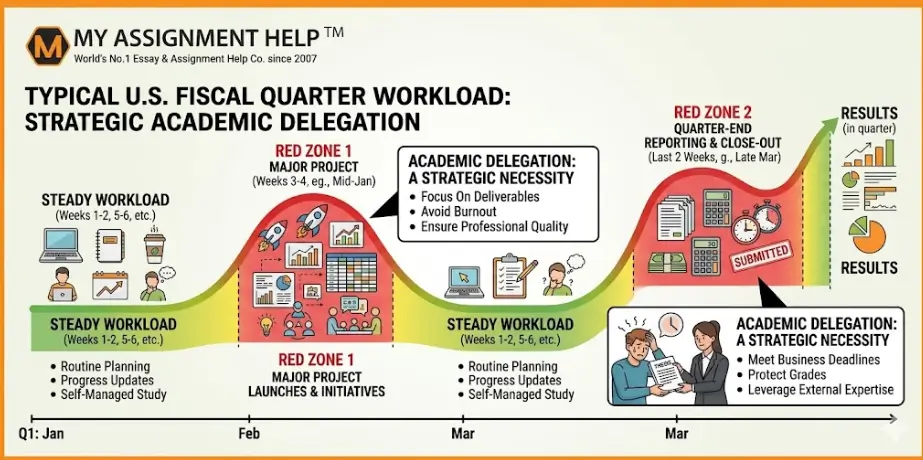
The goal is to live in Quadrant 2. However, when professional life enters a “Red Zone,” high-achievers often bridge the gap by securing a custom essay writing service to handle specialized USA-based curriculum requirements. This ensures that while you are excelling in the boardroom, your GPA isn’t collateral damage.
2. Deep Work and the “Context-Switching Tax”
Cal Newport, in his seminal work Deep Work, highlights that shifting between tasks creates “attention residue” that can lower productivity by up to 40%. For the online student, checking a work Slack message during a study block is the fastest way to lose two hours of progress.
To combat this, we recommend Identity Siloing:
- The 5 AM Sprint: Tackle your most research-heavy modules before your professional identity “wakes up.”
- The Delegation Buffer: During “Blackout Weeks” (like tax season or product launches), many students find it more efficient to pay for my essay from an expert rather than producing subpar work under duress.
The 2026 Professional Student Checklist (Downloadable Concept)
- [ ] Weekly Audit: Have you identified your “Peak Energy” hours?
- [ ] Syllabus Triage: Which 20% of assignments carry 80% of the grade?
- [ ] Hardware Check: Are you utilizing dual-monitor setups to separate “Work” from “Study” tabs?
- [ ] Contingency Plan: Do you have a vetted academic support partner for workplace emergencies?
See also: Digital Twins: The Future of Simulation
Frequently Asked Questions (FAQ)
How does E-E-A-T impact my online degree submissions?
In 2026, academic standards prioritize Experience and Expertise. Your submissions should blend your real-world professional insights with academic theory to satisfy modern grading rubrics.
Is outsourcing academic tasks common among US executives?
Yes. Much like hiring a consultant for a business project, busy professionals often view academic support as a tool to maintain high-level output across all areas of their life.
What is the best way to avoid “burnout” during a Master’s program?
Strictly compartmentalize your time. Use frameworks like the Pomodoro Technique and ensure you have one “Zero-Input” day per week to recover mentally.
Author Bio
James R. Sterling is a Senior Content Strategist at MyAssignmentHelp with over 15 years of experience in American ed-tech and academic consulting. Having navigated an online Master’s degree while working in corporate SEO, he provides practical, data-driven strategies for the modern “working student”.
Strategic References
- National Center for Education Statistics (NCES), 2025: Online Enrollment Trends.
- Newport, C. (2016). Deep Work: Rules for Focused Success in a Distracted World.
- Bureau of Labor Statistics (BLS), 2024: Time Use Patterns of Working Students in the US.



 By
By